Drakensberger Cattle
Pure Drakensberger cattle bred in QLD, Australia
Our Story, by Susan
Background
Drakensberger cattle entranced me when I first saw them in 1995 at the Rand Show in South Africa. I told the breeder that he had the best-looking Angus cattle that I’d ever seen - his response was a most indignant claim that they were Drakensberger NOT Angus! I loved them instantly. Researching the breed fueled a desire to import some to Australia however a lack of finances curtailed that dream.
How the wheel turns: 25 years later we are trying to save what is left of the population in Australia, a portion of them having endured successive years of misfortune and drought.
It was many years after our return to Australia through a series of fortunate events, some research and a few phone calls that I learned of a small herd of Drakensberger cows that had been imported to Australia via embryos.
Fortunately, two lots of 100 embryos arrived during a brief period of opportunity between 2004 and 2009. These are the source of my herd. Restrictions are currently in place and no further genetic material may be brought from Africa, so we feel it is important to maintain and build upon the work that has been done.
The Story of the Cows
The day after making contact with one of the brothers involved in importing the embryos, I was on my way to see some of his cows in Clifton, Queensland, Australia. Sadly, due to the drought they were in poor condition but still exciting to see. There were more cows and heifers near Esk, which I arranged to have a look at. Luckily at the last minute my husband David decided to join the expedition. After opening about 18 gates, we arrived and went in search of the stud cows. Unfortunately, we were only able to find less than half of the cows, all in very poor condition, scattered throughout a very big, steep, lantana-ridden paddock. Given the drought and condition of the animals present, the missing were presumed dead. That was a sombre moment.
We were there to look at heifers which were in another paddock. We got them and a lovely old bull into the yards, however the heifers were very unimpressive. David said I think if you want to do anything I would be buying those old cows or they’ll be dead in a few weeks. While the heifers were being yarded, David and I went back to see if we could somehow get the cows down into the yards from the very large, rugged paddock. This story is riddled with lucky circumstances. The cows we had found had started following a trail that lead to a fenced creek that was effectively a laneway to the yards. We hid behind some bushes until they were well into the creek and followed them into the yard paddock. The owner unhappily agreed to sell me the 15 purebred cows that were left.
The next drama involved getting them out of there. After many phone calls we accepted that it was impossible to get transport – everyone with a suitable vehicle was flat out hauling either cattle or hay in response to the widespread drought. Besides, most operators would not have loaded these cows as they were too poor and there was no loading ramp.
Long story short: we bought a truck and the property owner built a ramp. Loading them was an adventure with one of the cows so weak she went down and we only just snuck her on. Luckily, after 18 gates and numerous bumps she’d somehow got bounced onto her feet and never looked back. That was 'Sheryl' who took 18 months to recover and has now produced some decent progeny.
The cows were taken to our small property outside Pomona which had not been grazed for some time. Between that property and those of two or three generous neighbours we were able to scrap together around 100 acres to move between to heal the animals and get to know them through frequent interaction. The cattle ended up on two other properties farther afield in the Pomona and Cooroy areas while we came up with a plan.
We were able to buy a young bull, 'Barry', with differing genetic lines to the older cows. He turned out to be a very happy bull that loves a scratch behind the ears.
I was kindly allowed to go through the herd’s breeding records and was able to ascertain which of our animals were purebred Drakensberger and which had been crossed with angus and other breeds. While doing so I was treated with the best sponge cakes and delicious lunch.
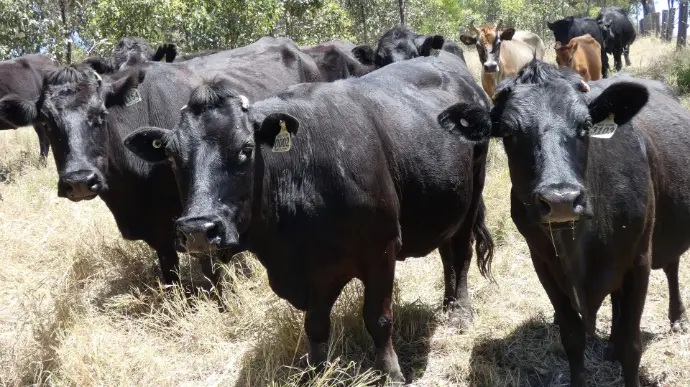
The ‘Drak adventure’ continued as I tried to locate cows that had been previously sold. I found some cows in Thargomindah and again got lucky when the owner agreed to sell them to me for meatworks value and even transported them to Dalby with other cattle that he was sending to the sale. This was when the inherent quiet nature of the Drakensbergers became evident. We had these seven- to nine-year-old cows that had only ever been run through the yards for annual preg-testing and weaning in a small timber yard and they never put a foot wrong, despite later demonstrating that they could have easily jumped out! Within three days they were behind a single strand of hot wire and within a week were comfortable with us walking around and through them.
The Story of 'Stinger'
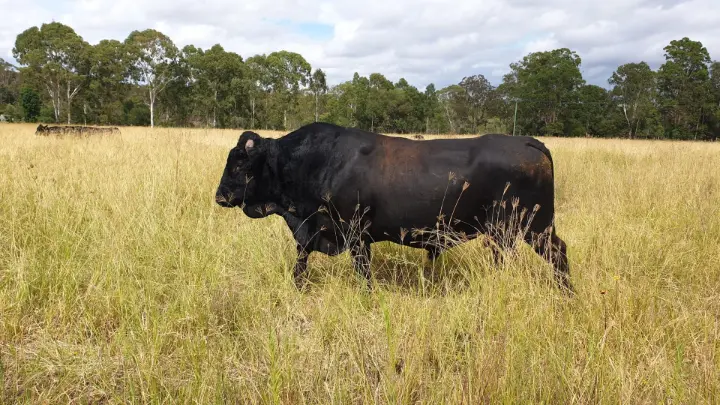
Five embryo bulls born in 2009 had been sold to Hampstead Springs, 150km north of Richmond in central Queensland. I contacted the owner who said one bull missed the muster last year which is why he was still alive (would have been culled for age, not ability). The owner mentioned being very impressed by this bull's performance in what he described as "hard country". He survived everything, including going on the road during a particularly bad drought, which saw one of his Drakensberger mates die from heart leaf poisoning. Having now seen him clear a grid without so much as a sniff we can see how he may have gotten on out there. Whilst he will lose condition when not much feed is about, we were told that he comes back into condition quickly, is sleek coated and produces plenty of calves (which can be identified by their black colour).
About three weeks later he called saying he’d found the old bull with some cows and was able to trail them into the yards. He didn’t think the yards would keep him for long so if I wanted him we had to get up there and get him right away. David set off in the truck for a very bouncy 3,500km round trip. He went to give the owner the money who said, "You might want to look at him first." David replied: "There’s no way I’m going back with an empty truck whether I like him or not!" We were kindly offered a refund if he didn’t work out.
David went via Rockhampton where we collected semen as an insurance policy. Later, back in Pomona, the bull charged down the race like a Sherman tank with a Bison head! My first thought was what the heck am I going to do with this bull? There’s no way we will ever keep him behind a strand of temporary electric fence. There were thoughts of neighbours calling with a wild bull in their back yard once he’d cleared all our fences!
The inherent good nature of the Drakensberger is evident in this bull. Despite having rarely seen humans over the previous eight years, he calmly does everything you ask of him without attitude. He got on and off the truck at Richmond, Clermont, Rockhampton and then at home without any sour behaviour. He had plenty of opportunity during that first trip to put David up the rails but always chose the right option.
After keeping him in the yards for a few days and feeding him I could pat him through the rail while he ate though he would wiggle his ears to demonstrate disapproval. Organic livestock pellets he found more yummy than my massaging distasteful! Within two weeks he would come to a whistle. We now move him frequently with the cows or other bulls and he has never had a go at us or tried to escape even when branches have fallen over the electric fence.
We named the bull 'Stinger' as David claims he could be driving one around if it wasn’t for my Drakensberger obsession!
So, when David now whinges about the energy that has gone into these Drakensbergers I just tell him it was meant to be, because if he had not come to Esk with me that day we would not have the cows at all - they’d all be dead and I’d have one lonely bull.
We have since relocated slightly inland to the South Burnett region, where breeding continues in order to form a solid cohort of viable females. The older cows are cell-grazed while their progeny are run under high-density management alongside other African breeds in a mixed herd.